





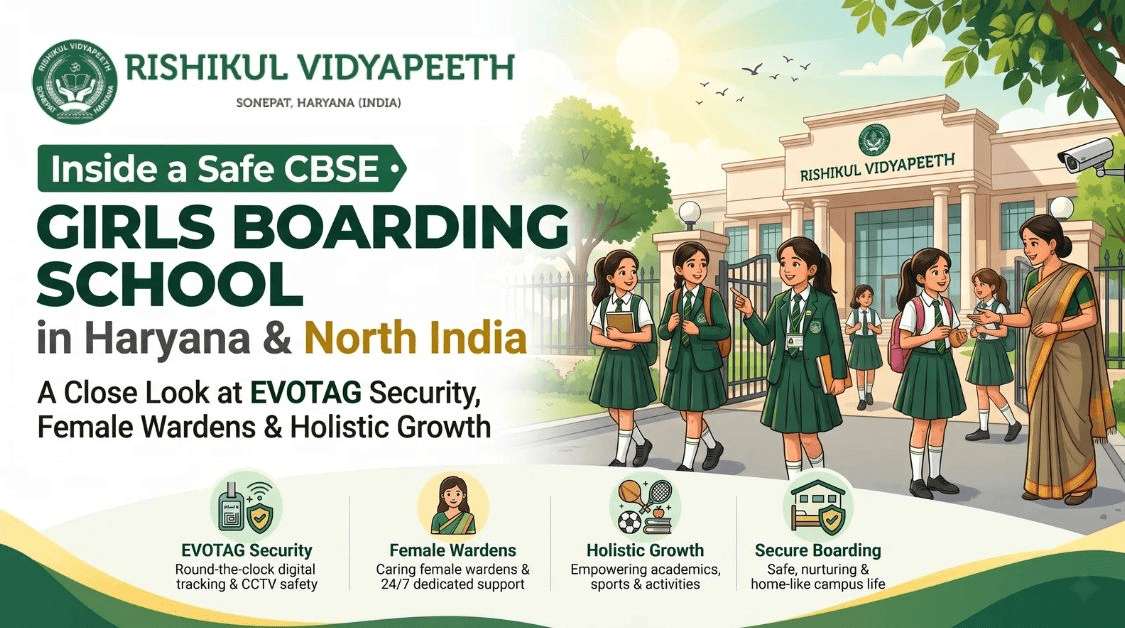
Inside a Safe CBSE Girls Boarding School in Haryana & North India: EVOTAG Security, Female Wardens & Holistic Growth
A safe CBSE girls boarding school in Haryana and North India protects daughters through strictly separate, female-warden-supervised air-conditioned hostels, real-time EVOTAG RFID tracking, 24x7 CCTV surveillance, an on-campus resident doctor and certified counsellor, self-defence training, and balanced co-educational classroom confidence.
When parents walk into our admissions office on Devru Road, Sonipat to talk about enrolling their daughter in boarding school, the conversation almost always starts with academics—CBSE results, stream choices, or sports facilities. Then, about ten minutes in, a father sets down the brochure or a mother pauses mid-sentence and asks the question they actually drove here to ask.
“Will she be truly safe here? Not just during school hours, but at ten o'clock on a winter night when she misses home, or when she falls ill with a fever, or when she walks back from evening sports?”
After more than three decades of residential schooling at Rishikul Vidyapeeth—founded on April 1, 1991, and trusted by generations of families looking for a CBSE girls boarding school in Sonipat and Haryana—we never brush past that hesitation with polite reassurances. Sending a daughter away from home is one of the heaviest emotional decisions an Indian family makes. No glossy brochure should ask you to take safety on faith.
Across Haryana, Delhi NCR, Punjab, Rajasthan, Uttar Pradesh, and NRI communities abroad, more families are actively choosing residential CBSE schooling for their daughters—not because they want distance, but because they want their girls to grow up with unhurried focus, physical strength, emotional poise, and independence away from two-hour urban commutes and late-night smartphone fatigue. What follows is an honest, ground-level look at how a truly safe girls boarding school in Haryana and North India operates behind the gates—hour by hour, policy by policy, and person by person.
Why Safety in a Girls Boarding School Means Far More Than High Walls
In India, the legal and regulatory expectations for residential schools have rightly become much stricter in recent years. The Ministry of Education’s Guidelines on School Safety and Security, the National Commission for Protection of Child Rights (NCPCR) Manual on Safety and Security of Children in Schools, the Protection of Children from Sexual Offences (POCSO) framework, and the National Education Policy (NEP) 2020 all point to the same principle: child safety in a residential school cannot be an informal promise. It has to be an engineered, accountable system.
Yet anyone who has actually worked inside a boarding campus knows that perimeter walls and gate locks are only the starting line. A girl living on campus experiences safety across four distinct layers:
- Physical and Perimeter Security: Knowing exactly who enters the campus, knowing where every student is at every hour, and maintaining strictly restricted access to girls' residential blocks.
- Medical Readiness: Having immediate, qualified clinical care on-site—not a first-aid box locked in a clerk's desk—backed by rapid multi-speciality hospital access when seconds matter.
- Emotional and Psychological Safety: Growing up in a zero-tolerance anti-bullying environment where adolescent anxiety, homesickness, or peer friction is met by trained counsellors and empathetic female wardens rather than silence.
- Digital and Lifestyle Safety: Protecting young girls from the quiet, modern hazards of unregulated late-night screen exposure, social-media comparison, and disrupted sleep.
When all four layers work together silently in the background, something remarkable happens. Girls stop spending mental energy worrying about their surroundings and start pouring that energy into robotics, debate, swimming, board preparation, and lifelong friendships.
Co-Ed Daytime Academics + Strictly Separate Girls Hostels: The Quiet Advantage
One of the first structural choices families face when exploring girls boarding schools in North India is deciding between a single-sex campus and a co-educational school that maintains completely separate, dedicated residential hostels for girls and boys.
Single-sex girls' schools carry deep heritage across parts of Haryana, Rajasthan, and Uttarakhand, and for some families they remain the default starting point. Over the last decade, however, we have seen a decisive shift among forward-looking parents—particularly those whose daughters plan to attend Delhi University, IITs, AIIMS, National Law Universities, or global campuses in Australia, the UK, and North America.
In the real world, engineering labs, surgical wards, corporate boardrooms, and university seminar rooms are not gender-segregated. When a girl spends her formative years studying exclusively inside an isolated single-sex bubble, the sudden transition into a mixed university environment at age eighteen can feel jarring.
At Rishikul Vidyapeeth, we follow a deliberate middle path that gives daughters the strongest elements of both worlds:
- During academic hours, clubs, debates, and school assemblies, boys and girls learn together as intellectual peers—challenging each other's ideas in Physics labs, collaborating on Atal Tinkering Lab prototypes, and representing nations side-by-side at Model United Nations conferences. Mutual respect stops being a textbook lecture and becomes an everyday habit.
- The moment the academic day transitions into residential life, the boundaries are absolute. Our Girls Hostel is a completely separate, dedicated residential complex with controlled access, supervised exclusively by female wardens and house mothers round the clock. Even at our aquatic complex, our three FINA-standard swimming pools maintain strictly separate changing rooms for girls and boys.
|
Campus Dimension |
Isolated Single-Sex Boarding School |
Metro Urban Day School (Delhi / Gurugram / Noida) |
Rishikul Vidyapeeth Girls Residential Model (Sonipat, Haryana) |
|
Residential Privacy & Protection |
High (girls-only campus) |
Not applicable (daily public/bus commute) |
Absolute — dedicated, separate female-supervised AC girls' hostel block |
|
Real-World Social & University Readiness |
Limited day-to-day academic collaboration with male peers |
Co-ed exposure, but fragmented by rushed commute schedules |
Balanced — confident co-ed classroom collaboration paired with protected residential living |
|
Daily Physical Safety & Commute Risk |
Zero daily commute |
90–120 minutes daily in dense urban traffic and evening tuition runs |
Zero daily commute — 3-minute supervised campus walk from hostel to classrooms |
|
Sports & Self-Defence Ecosystem |
Often limited to select indoor/cultural activities |
Short weekly P.E. periods; evening academies require parent escort |
16+ on-campus sports including FINA swimming, Taekwondo, Horse Riding & Tennis |
|
Distance from Delhi NCR & IGI Airport |
Often 5–8 hours away in remote hill stations or interior districts |
Local, but high urban AQI and noise |
45 km from New Delhi (~90 mins from IGI Airport) via NH-44 & UER-II/KMP |
That geographic balance matters deeply to North Indian and NRI parents alike. Situated on the quiet, tree-lined Devru Road institutional belt in Sonipat, the campus gives daughters clean air and expansive open space without placing them eight hours away in a remote mountain town where weekend family visits become logistical expeditions.
Inside Our Six-Layer Girls Hostel Safety Architecture
Parents rarely want vague adjectives like "world-class security." They want to know how protocols actually hold up on an ordinary Tuesday afternoon—or at 2:00 AM in January. Built around our campus-wide safety and surveillance architecture, here is how Rishikul Vidyapeeth's six operational layers protect residential girls every day.
Layer 1: Dedicated Female Wardens & House Mothers Who Live On-Site
Technology records events, but human presence prevents problems. Inside the girls' residential wing, supervision is handled by resident female wardens and nurturing matrons who live on campus and know every girl by name, temperament, and routine.
When a nine-year-old misses her mother during her first week of boarding, she does not need a rulebook—she needs a calm, steady adult who sits beside her, helps her settle in, and communicates warmly with her parents the next morning. Likewise, when a Class XI student feels overwhelmed before pre-boards, her warden notices immediately if she skips dinner or stays up too late. Accountability is personal, continuous, and deeply human.
Layer 2: EVOTAG RFID Real-Time Student Tracking
Modern residential campuses cover vast acreage—academic wings, laboratories, dining halls, swimming pools, and athletic fields. Relying solely on manual paper registers leaves blind spots.
Rishikul Vidyapeeth integrates the EVOTAG RFID tracking system, which monitors student movement across the school premises and on school buses in real time. Combined with mandatory institutional ID cards for every student and teacher, movement between academic blocks, sports arenas, and hostel wings stays transparent and verifiable at every step.
Layer 3: 24x7 Eagle-Eye CCTV Surveillance & Strict Visitor Gate Control
High-definition CCTV cameras cover classrooms, laboratories, corridors, staircases, common activity zones, entry gates, and hostel perimeter corridors round the clock. Crucially, camera footage is not left sitting unwatched on a server; it is regularly audited by senior school authorities.
At the school main gate, trained security personnel enforce strict entry control:
- Unauthorized entry onto campus grounds is completely barred.
- Every visitor is logged in the official Visitor's Log Book with identity verification and issued a Temporary Visitor Identity Card before stepping inside.
- Only parents and officially pre-authorized Local Guardians—whose photographs and government photo IDs are recorded on file at the time of admission—are permitted to meet or sign out a residential student.
Layer 4: 24x7 Resident Doctor, On-Campus Infirmary & Hospital Proximity
Every boarding parent eventually asks the two-o'clock-in-the-morning medical question: What happens if my daughter develops a high fever, an asthma flare-up, or a sports sprain overnight?
Through our 24x7 on-campus medical infirmary and resident doctor, clinical response is immediate rather than improvised:
- A full-time Resident Doctor is available round the clock, supported by a visiting team of qualified doctors and nurses seven days a week.
- Our well-equipped on-campus Infirmary provides isolated rest, observation, and basic medical treatment, while the hostel kitchen prepares special, easily digestible meals for ailing students.
- Periodic medical check-ups and physician-led sessions on adolescent health and personal hygiene are built directly into the school calendar.
- For any serious ailment or specialist emergency, the campus maintains direct referral access to a multi-speciality hospital located approximately 1 km from the school, accompanied by immediate telephonic notification to parents.
Layer 5: Certified Adolescent Counselling & Zero-Tolerance Anti-Bullying
Adolescence brings real emotional weather—academic pressure, shifting friendships, body-image questions, and the push for independence. In many schools, counselling only enters the picture after a crisis.
At Rishikul Vidyapeeth, our certified school counsellor conducts regular, structured counselling sessions specifically tailored for girls in the secondary and senior wings. These sessions create a confidential, non-judgmental space to manage exam stress, talk through personal boundaries, and make grounded decisions during the teenage years. Alongside individual counselling, we run dedicated sessions on personal safety and enforce an uncompromising zero-tolerance anti-bullying policy, continuously reinforced through residential life mentoring discussions and seminars.
Layer 6: Distraction-Free, Screen-Safe Hostel Rooms
Ask any child psychologist in India today what poses the quietest threat to teenage girls' emotional safety, and the answer is rarely the playground—it is the unsupervised bedroom smartphone at midnight. Late-night social media feeds fuel sleep deprivation, comparison anxiety, and cyberbullying.
To protect every student's peace of mind, hostel rooms at Rishikul Vidyapeeth are completely free of personal smartphones and room televisions. Rooms are fully air-conditioned and designed strictly for rest, reading, and quiet camaraderie. Recreational television and curated movie screenings take place together in the common hall on Sundays, while family communication happens through scheduled phone calls and our structured School ERP updates.
|
Safety & Wellbeing Layer |
Operational Standard Inside Rishikul's Girls Hostel |
Direct Benefit for Your Daughter & Family |
|
Residential Supervision |
Strictly separate girls' hostel building led by on-site female wardens & matrons |
Round-the-clock maternal care, emotional warmth, and protected privacy |
|
Movement Accountability |
EVOTAG RFID real-time student tracking (campus + buses) & mandatory ID cards |
Zero blind spots across academic blocks, sports fields, and transit |
|
Access & Surveillance |
24x7 audited CCTV across corridors/common areas, guarded main gate & Visitor Log |
Complete prevention of unauthorized entry; verified parent/guardian access only |
|
Medical & Hygiene Care |
Full-time resident doctor, 7-day medical team, infirmary, special sick meals & hospital ~1 km away |
Immediate clinical intervention day or night; proactive adolescent hygiene care |
|
Emotional & Social Safety |
Certified counsellor, periodical girls' counselling sessions & zero-tolerance anti-bullying |
Confident, resilient teenagers free from peer intimidation or silent stress |
|
Digital Hygiene |
Zero room TVs or personal smartphones; supervised Sunday common-hall recreation |
Deep 8-hour sleep, freedom from cyberbullying, and sustained study concentration |
Why One Hostel Does Not Fit Every Age: Growing Safely from Age 4 to Age 17
One of the most common mistakes in residential education—and a detail parents often overlook until after enrollment—is placing young primary children in the same residential wing as Class XII board aspirants. An eight-year-old who needs help organizing her school bag and developing healthy eating habits has nothing in common with a seventeen-year-old revising organic chemistry until 9:50 PM.
That is why Rishikul Vidyapeeth maintains age-segregated girls residential wings for ages 4–9, 9–12, and 12–17, tailoring the pace of care, evening discipline, and emotional support to each stage of childhood:
Primary Girls Wing (Ages 4 to 9 Years | Classes I–V)
Young boarders need warmth first and formality second. In our Primary Wing, female matrons provide close, individualized attention focused on emotional security and gentle habit-building. Little girls learn tidy personal routines, healthy food habits, and table manners at shared dining tables. Afternoons balance guided homework completion with indoor games, outdoor play, storytelling, music, and unhurried joy—ensuring hostel life feels like a lively extended family rather than a rigid institution.
Middle Girls Wing (Ages 9 to 12 Years | Classes VI–VIII)
These bridge years are where confidence either takes root or shrinks back. In the Middle Wing, daily life shifts gently toward self-reliance and curiosity. Alongside supervised study hours and dedicated homework completion classes, students who need extra clarity in Mathematics, Science, or English receive individualized Shadow Teaching right on campus—eliminating the stigma or exhaustion of falling behind. Hobby clubs, Sports for All, daily yoga sessions, supervised recreational outings, and our Sunday Communication Skill Development Programme help pre-teen girls find their voice early.
Secondary & Senior Secondary Girls Wing (Ages 12 to 17 Years | Classes IX–XII)
By Class IX, academic goals sharpen around CBSE Board Examinations and competitive pathways like NEET, IIT-JEE, CUET, CLAT, Design, or international admissions. Senior girls live in a calm, high-focus residential wing built around structured evening prep (7:50 PM to 9:50 PM), Sunday Extra Classes by subject experts, peer study support, and regular mentoring from our certified counsellor. Rather than burning hours commuting to crowded evening coaching hubs, senior girls study under faculty supervision, unwind through evening sports and yoga, and enjoy supervised weekend movie time with their batchmates.
Raising Strong, Capable Daughters: Academics, STEM, Diplomacy & 16+ Sports
True protection does not mean wrapping a daughter in bubble wrap; it means giving her the intellect, physical capability, and voice to walk into any room in the world unafraid. As a leading CBSE boarding school for girls, Rishikul Vidyapeeth pairs safety with high-ambition academic, technological, global, and athletic opportunities.
Academic Consistency Without Coaching Burnout
Maintaining a 100% pass record in CBSE Class X and Class XII Board Examinations comes down to steady daily craft. With a 1:30 teacher-student ratio, teachers know every girl's writing style, analytical strengths, and weak chapters long before exam season arrives. Classroom instruction aligns squarely with CBSE’s 50% competency-based assessment pattern—prioritizing case studies, conceptual reasoning, and applied problem solving over rote memorization.
In Classes XI and XII, girls can choose from Senior Secondary streams across Medical, Non-Medical, Commerce, and Humanities, combining core subjects with contemporary electives such as Computer Science, Psychology, Entrepreneurship, Marketing, Banking, Painting, Music, and Physical Education. For meritorious scholars and state or national sports medallists, our Maya Sharma and S.K. Sharma scholarship initiatives further recognize and reward excellence year after year.
Breaking Stereotypes in STEM, Global Diplomacy & International Pathways
Girls in residential schools should never be steered quietly into narrow boxes. At Rishikul Vidyapeeth, daughters take center stage across science, diplomacy, and global exchange:
- Atal Tinkering Lab (ATL) & Imaginarium: Girls design robotics prototypes, explore 3D printing, code IoT sensors, and present working scientific innovations at our annual Imaginarium showcase.
- Global Exposure Right from Sonipat: Through 15 sister schools abroad, our active Cultural Exchange Programme with Japan, our Group of Eight (Go8) Australia university tie-up, UNESCO ASPnet and iEARN global projects, hosting IIMUN (India's International Movement to Unite Nations), hosting the College Board International AP Workshops, and operating an official on-campus SAT Test Centre, girls graduate with a genuinely international outlook rooted in Indian cultural grace.
Physical Strength, Self-Defence & 16+ Championship Sports
Haryana is India's undisputed heartland of women's Olympic and international athletics—and girls living on our Devru Road campus train inside one of North India's finest school sports complexes. Every evening (starting around 5:15 PM in summer and 4:45 PM in winter), girls step onto the fields across 16+ coached sports disciplines led by NIS-certified coaches:
- Taekwondo & Self-Defence: Structured martial arts training under NIS-certified instructors that builds reflexes, core strength, spatial awareness, and practical self-defence confidence.
- Aquatic Centre (3 FINA-Standard Pools): A 50-meter Olympic pool, a 25-meter training pool, and a kids' learner pool maintained to international FINA standards, complete with dedicated separate changing rooms for girls and strict pool hygiene and safety norms.
- Lawn Tennis: Three international-standard synthetic courts built in collaboration with Australia Rebound.
- Horse Riding: A dedicated equestrian arena with well-bred horses and certified riding guides—cultivating balance, posture, and fearless composure.
- Gymnastics, Athletics, Court & Mind Sports: A state-of-the-art indoor Gymnastics arena, a 300-meter athletics track, Basketball, Badminton, Volleyball, Skating Rink, Table Tennis, Chess, a 13-acre Football ground, Cricket, and a tranquil Yoga Centre for breathwork and mindfulness—complemented by Vocal & Instrumental Music and Arts & Crafts.
Nourishment, Daily Rhythm & Staying Close From Miles Away
When a mother hands over her daughter's daily care to a boarding school, two quieter questions always follow security: Will she eat well? and Will we stay truly connected?
Wholesome Vegetarian Dining & Mindful Daily Structure
Our in-house hygienic mess serves 100% nutritious vegetarian cuisines at fixed, unhurried mealtimes—morning breakfast at 7:30 AM, wholesome lunch after school, afternoon milk and snacks before evening sports, and warm dinner before lights out. Meal menus are thoughtfully balanced for growing teenagers and active student-athletes, and special light meals are prepared whenever a student is recovering in the infirmary.
Life follows a steadying rhythm from a 5:30 AM wake-up and morning yoga/drills through classes, afternoon rest or shadow teaching, two hours of outdoor games, supervised evening study, and an early night. Every Sunday blends subject-expert extra classes, our Communication Skill Development Programme, supervised recreational movie time, and occasional escorted outings, while a monthly Hawan anchors the community in our founding ethos of Vasudhaiva Kutumbakam—the world is one family.
Transparent Parent Communication Without Guesswork
Distance never means being left in the dark. Through the School ERP system, parents across Haryana, Delhi NCR, and overseas receive regular updates on academic assessments, attendance, co-curricular achievements, and monthly Parent-Teacher Meeting (PTM) invitations. For any urgent health or personal update, our hostel wardens and wing heads reach parents immediately by telephone.
We also believe in honest communication before enrollment begins. Prospective families are always welcome to tour the campus—to walk inside an actual classroom, step into a girls' hostel room in their daughter's age wing, visit the dining hall during mealtime, see the infirmary, and sit down directly with the hostel warden and counsellor. (As noted in our Haryana boarding school parent evaluation guide, we intentionally do not encourage one-night "trial stays": a single night sleeping among unfamiliar faces rarely reflects the warmth and rhythm of real boarding life. Meeting the people who will actually care for your daughter tells you far more.)
Frequently Asked Questions About Girls Boarding Life in Haryana & North India
1. Are girls and boys kept in completely separate hostels at Rishikul Vidyapeeth?
Yes. While students study together in co-educational classrooms and participate jointly in academic clubs and competitions to build balanced social confidence, Rishikul Vidyapeeth maintains completely separate, fully air-conditioned residential hostel buildings for girls and boys. The girls' hostel is supervised round the clock by dedicated female wardens and matrons, with strictly restricted entry and 24x7 CCTV monitoring across corridors and entry points.
2. How does the school handle medical emergencies for residential girls at night?
Rishikul Vidyapeeth has a full-time resident doctor on campus, supported by a visiting team of qualified doctors and nurses seven days a week and a well-equipped infirmary that provides special care and tailored meals for unwell students. In the event of any serious medical condition requiring specialist care, the student is immediately referred to a multi-speciality hospital located approximately 1 km from campus, and parents are notified right away.
3. How are younger girls (Classes I–V) cared for differently from teenage boarders?
Our hostels are strictly segregated by age into three dedicated wings: Primary (4–9 years), Middle (9–12 years), and Secondary & Senior Secondary (12–17 years). Primary girls receive warm, individualized maternal care focused on emotional security, table manners, and gentle homework support, whereas senior girls live in a focused academic wing with supervised evening study hours, Sunday expert classes, and board-exam counselling.
4. Are personal smartphones or televisions allowed inside girls' hostel rooms?
No. To safeguard sleep quality, academic focus, and emotional wellbeing, personal smartphones and televisions are not permitted inside hostel rooms. Students enjoy supervised television and movie time together in the common hall on Sundays, while staying connected with parents through scheduled calls and School ERP progress updates.
5. How far is Rishikul Vidyapeeth from Delhi NCR and IGI Airport for weekend visits or NRI travel?
Located on Devru Road in Sonipat, Haryana, the campus is approximately 35–45 km from North and West Delhi via NH-44 and roughly 90 minutes from Indira Gandhi International (IGI) Airport via UER-II and NH-44—making weekend family visits and holiday travel smooth for both Delhi NCR and NRI families.
Come Walk the Campus Before You Decide
Choosing a safe CBSE girls boarding school in Haryana or North India is too important a decision to make from a screen alone. Come walk our corridors on Devru Road, meet the female wardens who anchor our girls' wings, speak with our counsellor, and watch our students on the sports fields at dusk.
Registrations for the 2027–28 academic session are now open. You can book a guided campus visit with our Admission Office by calling +91 94160 74444 (Admission Helpline) or +91 86074 46472 (Hostel Helpline), email info@rishikulvidyapeeth.edu.in, or submit our Online Admission Enquiry Form today. (Meetings with the Principal are scheduled by prior appointment so we can give your family our undivided time.)
