





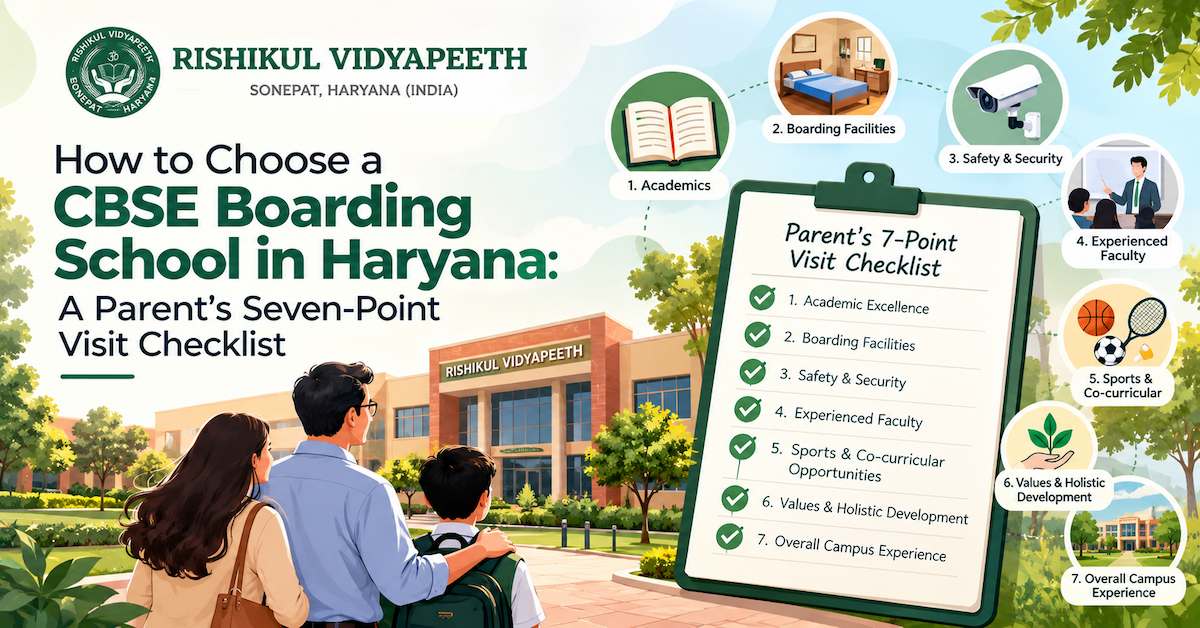
How to Choose a CBSE Boarding School in Haryana: A Parent's Seven-Point Visit Checklist
What to look at, what to ask, and what the CBSE changes for 2026–27 mean for your child, with notes on how we approach each point at Rishikul Vidyapeeth, Sonipat.
Haryana has a long tradition of producing athletes and a growing reputation for residential schooling along the NH-44 corridor. Families from across the state, from neighbouring states and from Delhi NCR now consider boarding here. That is good news for parents, but it also means more brochures, more adjectives and more promises.
When a family visits us, we always say the same thing: don't judge a school by its brochure. Judge it by what you can see, touch and ask. This guide is the checklist we would use ourselves if we were choosing a boarding school for our own child. Use it at any school you visit, including ours. Where it helps, we show how Rishikul answers each point, and where a point depends on your child, we say so.
The one-page checklist
|
What to check |
Questions to ask on your visit |
How Rishikul answers |
|---|---|---|
|
1. Academics & board preparation |
How is the school preparing students for the new CBSE paper pattern? Is outside tuition expected? |
1:30 teacher-student ratio; competency-based learning and assessment; extra classes, shadow teaching and supervised study; we discourage outside coaching |
|
2. Hostel and age grouping |
Are boys and girls in separate hostels? Are young children kept apart from teenagers? |
Separate boys' and girls' hostels, fully air-conditioned rooms, three age wings (4–9, 9–12, 12–17) |
|
3. Sports & coaching |
Who coaches? Is it free or charged? Is there a facility for my child's sport? |
16 sports and activities; NIS and BCCI-certified coaches; some games free, others charged |
|
4. Safety & wellbeing |
How are children tracked? Who handles bullying, health and homesickness? |
EVOTAG tracking, CCTV, guarded gates, ID cards and visitor log, full-time doctor, infirmary, counsellor |
|
5. Food & daily routine |
Can I see the mess and the menu? What does a day look like? |
Vegetarian mess at fixed times, published menu and 24-hour schedule |
|
6. Cost transparency |
What exactly is included? What is extra? What is refundable? |
Published fee PDF and sports charges page; ₹10,000 caution money is refundable |
|
7. Values & fit |
What are the rules? Will my child be comfortable with them? |
Code of discipline, English on campus, uniform and yoga, Indian ethos |
1. Academics: the board exam has changed, so ask how the school has
If your child is heading to Class X or XII in the coming years, this is the question we would ask first. Two developments are worth knowing:
- More application-based questions. Reports on the CBSE pattern for the 2025–26 board cycle describe about half of the paper as competency-based (case studies, source-based and application questions), with roughly 20% multiple-choice and 30% descriptive. The shift rewards children who can apply ideas, not just remember them.
- Two board exams for Class X. From 2026, Class X students can sit two board examinations in the same year. For 2027, the main exam is expected in February–March and the second, improvement-oriented exam in May. Class XII remains a single exam. At the time of writing, CBSE had not yet released the 2027 date sheet, so please check cbse.gov.in for confirmed dates.
What does that mean for a boarding school? It means the school's teaching has to be about thinking, not coaching for recall. Rishikul describes its approach as ASK: Application, Skill and Knowledge, built on multiple intelligences and project-based learning, with a dedicated page on competency-based learning and assessment. Boarders also get what a day student often pays extra for: an after-school extra class, supervised study every evening, shadow teaching for children who are finding a subject hard, and Sunday extra classes by subject experts. Our admission rules go further and state that the school discourages extra tuition and outside coaching, and we mean it.
On results: any school that says “100% results” should show you the data. Ours are published year by year on the Results page, and we would encourage you to look at them, and to ask any other school for theirs.
2. Hostels: gender separation and age grouping
The first thing to check is whether boys and girls live separately. At Rishikul they do, even though they study together in class. The second is whether children of very different ages share the same space. A six-year-old and a sixteen-year-old need different things, so our hostels are grouped by age:
9–12 years
|
Wing |
Age group |
What the wing focuses on |
|---|---|---|
|
Primary |
4–9 years |
Individual attention for emotional well-being, shaping food habits and table manners, fun and games, indoor and outdoor play |
|
Middle |
Shaping behaviour, hobby classes, sports for all, homework completion classes, shadow teaching, supervised study, yoga, outings and communication skills |
|
|
Secondary & Senior |
12–17 years |
Extra classes for academic excellence, supervised study hours, sports and yoga, movie time |
Rooms are fully air-conditioned. The other thing to look for on any visit is the warden: ask to meet the person who will actually be responsible for your child, and ask how they handle a child who cries at night in the first week. The answer tells you more than any facility list.
3. Sports: look at the coaching, not just the grounds
Haryana is a sporting state, and sports infrastructure is easy to photograph. What matters is whether your child will actually be coached. Here is what the Multi Sports Centre lists:
|
Sport |
What the school states |
|---|---|
|
Swimming |
Three pools (50 m, 25 m and a kids' pool) maintained to FINA standards, with separate changing rooms for boys and girls |
|
Cricket |
Described as Haryana's largest cricket academy, with BCCI Level-A certified coaches |
|
Football |
A 13-acre football ground with regular practice under NIS-certified coaches |
|
Lawn tennis |
Three synthetic courts built in collaboration with Australia Rebound |
|
Boxing, taekwondo, gymnastics, basketball |
Coached by NIS-certified or NIS-trained coaches |
|
Horse riding |
Well-bred horses and certified guides |
|
Athletics, skating, volleyball, badminton, table tennis, chess, yoga |
300 m track, a skating rink, a yoga centre with dedicated trainers, and coached training |
As we explain in our fee guide, some of these are free for students (volleyball, basketball, table tennis, athletics, skating, gymnastics) and others carry a separate charge (swimming, football, cricket, boxing, badminton, horse riding and tennis). Wherever you apply, ask to see the sports charges in writing. For children with real athletic ambition, the school also recognises achievement through its sports scholarship categories, such as first three positions at district, state or national level.
4. Safety and wellbeing
Parents of boarders are, understandably, thinking about this more than anything else. A good boarding school should be able to answer these questions without hesitation. Ours:
- Who is on campus? Trained guards at the main gate, ID cards for students and teachers, temporary ID cards for visitors, and a visitor log.
- Where are the children? The EVOTAG system lets the school and parents track the whereabouts of children within the premises and in school buses.
- Who is watching? CCTV in classrooms, labs, corridors and other important locations, with the footage regularly checked by school authorities; hostels have round-the-clock CCTV surveillance.
- What about bullying? It is not tolerated in any form. Residential life discussions, mentoring topics and seminars address it on a regular basis.
- What if my child is unwell? A full-time doctor and an infirmary on campus; serious cases go to a multi-speciality hospital about 1 km away.
- Who can my child talk to? A certified counsellor, and counselling sessions on safety and security.
5. Food and daily life
Ask to see the mess at mealtime, not an empty hall. We serve vegetarian food prepared in hygienic conditions at fixed times, and the menu is published on our website. The rest of the day is structured: morning exercises and drills, school, an extra class, games, supervised study and an early night. You can see all of it in the published 24-hour schedule. We also add things that are not academic but matter: music, dance, arts and crafts, a Sunday communication programme, a monthly hawan, and outings.
6. Cost: ask for the whole picture
The school with the lowest quoted fee is not always the cheapest. Ask for a complete, itemised yearly figure, and ask what is billed outside it. Our own fee structure is public, and we have written a separate, line-by-line guide to it. For orientation, our tentative 2026–27 total for a continuing boarder runs from ₹3,10,900 to ₹3,34,700 a year depending on class, with sports coaching billed separately. Check the fee structure PDF for current numbers.
7. Values and fit: the question most checklists miss
Every boarding school has a culture, and it won't suit every child. At Rishikul, students follow a code of discipline, speak English on campus, wear the prescribed uniform, and take part in school functions and activities. Fines can be imposed for things like missing uniform or being late. The admission rules also state that a student must live either in the hostel or with parents in Sonipat. Many families value that clarity. Some children flourish with it, and some find it too structured.
Our honest suggestion: sit down with your child before you visit and ask what they are most excited and most nervous about. Then watch how they respond to the hostel, the other children and the staff. The right school is the one where your child can picture themselves.
What to do next: a simple plan for your visit
- Book a visit through the Admission Helpline. Request time with the Principal or counsellor in advance, since the Principal meets visitors by appointment.
- See a classroom, a hostel room in your child's age wing, the mess, the infirmary and at least one sports facility your child cares about.
- Ask for the current fee PDF, the sports charges and the list of documents in writing.
- Talk to a warden and, if possible, to current parents.
- Compare two or three schools using the same checklist, and decide only after you have slept on it.
Frequently asked questions
1. What should I look for first in a CBSE boarding school in Haryana?
Start with the basics a child lives with every day: gender-separate hostels grouped by age, a transparent fee structure, proper safety systems, and an academic approach that matches the new competency-based CBSE pattern. Then check sports and values for fit.
2. Are there separate hostels for boys and girls at Rishikul?
Yes. Boys and girls study together in school but live in separate hostels, in age-grouped wings.
3. What safety measures does the campus have?
EVOTAG tracking on campus and in school buses, CCTV, guarded gates, ID cards and a visitor log, an infirmary with a full-time doctor, a certified counsellor, and a no-bullying policy.
4. Which sports can my child play?
Sixteen sports and activities are offered through the Multi Sports Centre, including swimming, cricket, football, tennis, boxing, horse riding, gymnastics, athletics and chess. Some are free for students and others carry a separate charge.
5. What is the Class X two-exam system?
From 2026, CBSE allows Class X students to appear in two board exams in the same year: a main exam (February–March) and a second exam (expected in May). Check cbse.gov.in for the official 2027 schedule.
6. How do I apply?
Call +91 94160 74444 or use the online enquiry form. Applications are normally accepted in December and January, and admission is based on a written aptitude test and an interactive session.
Visit before you decide
We would be glad to show you around. Bring your questions and your child.
Admission Helpline: +91 94160 74444 · info@rishikulvidyapeeth.edu.in · Admission enquiry form · Contact the Admission Office
