





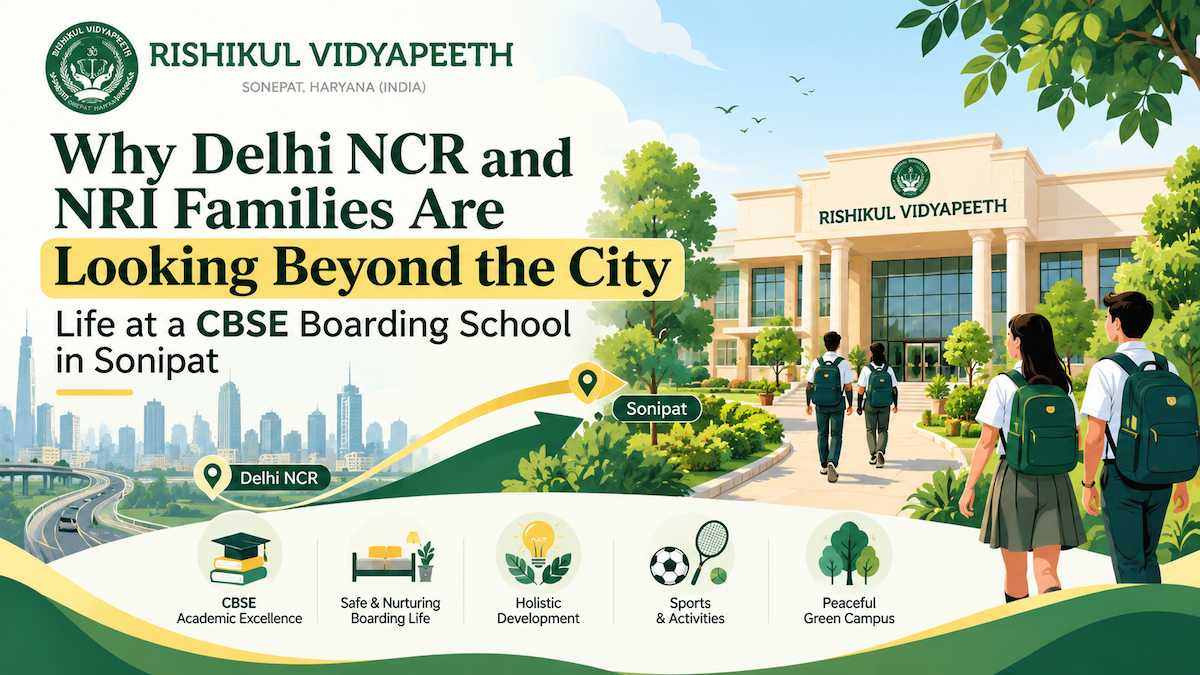
Why Delhi NCR and NRI Families Are Looking Beyond the City: Life at a CBSE Boarding School in Sonipat
A parent-friendly look at the daily routine, the distance, the admission paperwork and the honest trade-offs of choosing residential schooling just north of Delhi.
Each autumn we hear a version of the same story from Delhi NCR parents. School begins early, the commute eats into the day, evenings disappear into traffic, homework and tuition classes, and by the time a child has a free hour they are too tired to use it. When winter air quality dips across the NCR, that tiredness gets a little harder to ignore.
Some of those families begin to ask a different question: what if school and home were not the same long journey? A boarding school far away in the hills solves the commute, but it creates another problem, which is distance from family. For many parents, a campus about an hour or so north of Delhi starts to look like a sensible middle path. That is the case we want to lay out here, including the parts that may not suit every child.
1. Where we are, and how far that really is
Rishikul Vidyapeeth stands on Devru Road in Sonipat, Haryana, spread over 43 acres. The school was founded on 1 April 1991 by Sh. S K Sharma, and it is a CBSE-affiliated day-cum-residential school.
For NRI families the first practical question is the airport. Our own FAQ answers it plainly: we are about an hour and a half from Indira Gandhi International Airport. We do not provide airport pick-up or drop, so families or their local guardians arrange that themselves. Drive times from different parts of Delhi NCR vary a lot with traffic and time of day, so we suggest checking your own route on a map app before planning a weekend visit.
2. Day school in the city vs a boarding routine: what actually changes
We don't think one is better than the other for every child. They are different lives, and it helps to see the differences side by side.
|
|
A typical city day-school week |
Boarding at Rishikul |
|---|---|---|
|
Travel |
Daily commute by bus, car or van; time varies with the route |
A short walk or ride from hostel to the academic block |
|
Evenings |
Mostly at home; homework, tuition and screens compete for time |
Games from about 5:15 pm (summer) or 4:45 pm (winter), then supervised study from 7:50 to 9:50 pm |
|
Academic support |
Often outside tuition for doubts |
Extra class after school, supervised study, shadow teaching, and Sunday extra classes by subject experts |
|
Screens |
Depends on the household |
No TV sets in hostel rooms; a common TV room is used on Sundays only |
|
Family time |
Every evening |
Time together on visits and holidays; parents stay informed through the school ERP, PTMs and emergency calls |
|
Independence |
Parents handle most daily logistics |
Children learn to manage time, laundry, belongings and friendships, with wardens close by |
The last two rows are the real trade-off. A child in boarding gains structure and independence and gives up the everyday closeness of living at home. If your child is very young, very anxious about separation, or you are not ready for that distance yourselves, say so openly when you speak to us. That is a legitimate reason to wait or to consider day schooling first.
3. A day in a boarder's life
The school publishes a 24-hour boarders' schedule by class group. Our FAQ says students rise by 5:30 am and are ready for breakfast at 7:30 am after drills and exercises. The table below is a simplified version of the published schedule for Classes I–XII (the document is dated 2023, so please confirm the current timings with the hostel office).
|
Activity |
Summer timings |
Winter timings |
|---|---|---|
|
Morning chores & PT |
5:00–6:00 am |
6:00–7:00 am (Classes I–VIII); 5:00–6:00 am (IX–XII) |
|
Bath / wash |
6:00–7:30 am |
7:00–7:30 am (I–VIII); 6:00–7:30 am (IX–XII) |
|
Breakfast |
7:30–7:45 am |
7:30–7:45 am |
|
School hours |
8:00 am–2:00 pm, with lunch around 12:15–12:40 pm |
8:30 am–2:30 pm, with lunch around 12:10–12:35 pm |
|
Extra class |
2:00–2:45 pm |
2:30–3:15 pm |
|
Rest / self-study / laundry |
2:45–4:45 pm |
3:15–4:15 pm |
|
Refreshment & attendance |
4:45–5:15 pm |
4:15–4:45 pm |
|
Games |
5:15–6:15 pm |
4:45–5:45 pm |
|
Evening chores / rest |
6:15–7:30 pm |
5:45–7:30 pm |
|
Dinner |
7:30–7:50 pm |
7:30–7:50 pm |
|
Supervised / self-study |
7:50–9:50 pm |
7:50–9:50 pm |
|
Lights out |
10:00 pm |
10:00 pm |
Beyond the timetable, the rhythm of the week includes things we are fond of: a Communication Skill Development Programme on Sundays, occasional movie and dinner outings, and a monthly hawan. Evening classes in music, dance, yoga and arts and crafts give children something to look forward to that isn't a screen.
4. Boys and girls: how the hostels are organised
In class, boys and girls learn together, much like any other CBSE school. In the hostels, they are separate, with a separate boys' hostel and girls' hostel and wings grouped by age: Primary (4–9 years), Middle (9–12 years), and Secondary & Senior (12–17 years). This matters more than it sounds. A seven-year-old needs warmth, help with table manners and gentle habit-building; a sixteen-year-old preparing for board exams needs quiet study hours and room to take on responsibility. Putting them in the same corridor serves neither.
Hostel rooms are fully air-conditioned, food is vegetarian, and the mess serves meals at fixed times (the mess menu is published on the website). Round-the-clock CCTV, an infirmary and a full-time doctor are part of the picture, along with a certified counsellor for children who need someone to talk to.
5. If you live abroad: what NRI families should know
Rishikul is a global-minded school. We have links with leading schools abroad, a partnership with a group of Australian Go8 universities, student exchange programmes, and a SAT centre on campus for students aiming at universities overseas. Our teaching staff includes both local and expatriate teachers, selected after interviews and demonstration lessons.
At the same time, the school is deliberately rooted in Indian values. Our FAQ describes Indian ethos, festivals, yoga and the idea of Vasudhaiva Kutumbakam, the whole world as one family, as part of daily life. For NRI parents who want their children to grow up connected to India while keeping global options open, that blend is the point.
How admission works
- Entrance: a written aptitude test in English, Maths and General Awareness (based on the previous class's NCERT syllabus), followed by an interactive personality session. Hostel applicants submit a medical fitness certificate.
- Timing: applications are normally accepted in December and January, and you can apply online.
- Other boards (ICSE, IB, IGCSE, state boards): welcome, with the previous mark sheet and a transfer certificate attested by the board or competent authority.
- Class X and XII: direct admission is not normally allowed; it can be granted only in rare cases with CBSE permission. For Class X, the Class IX marksheet with grades is required.
Documents to keep ready
The school's documents page and admission form list the paperwork. In plain terms, have these ready:
- School Leaving Certificate or Transfer Certificate, countersigned by the competent authority if the child is coming from a board other than CBSE.
- Proof of date of birth, the student's Aadhaar copy, and the previous class marksheet (plus migration certificate and registration numbers where applicable).
- Government photo IDs of father, mother and guardian.
- For NRIs and foreign nationals: a copy of the passport with valid visa; foreign-passport holders also need a copy of their residential permit.
- For boarders: a medical certificate, an affidavit by the parents to abide by school norms, and the details and photographs of up to two local guardians in India who are authorised to visit and respond in an emergency.
- Passport-size photographs of the child and one each of parents and guardian. The school's pages list different numbers for the child's photographs, so please confirm the current count when you apply.
A practical tip for NRI parents: choose your local guardians carefully. They are the people the hostel will call first when you are in another time zone, so pick someone nearby, reliable and happy to be reachable.
6. Staying in touch from far away
The school contacts parents directly in an emergency, and otherwise shares academic progress and activity participation through the school ERP system, along with invitations to monthly parent-teacher meetings. If you live abroad and cannot attend in person, ask our admissions team how other overseas parents manage this. We would rather you know the arrangement in advance than assume.
7. Visiting before you decide
Prospective parents are welcome to visit at their convenience; to meet the Principal you will need an appointment. Interestingly, we don't encourage trial overnight stays. Our FAQ explains why: a one-night visit is an artificial experience among strangers and tells you little about real boarding life. A better use of your time is to see the hostel rooms and mess, speak to the counsellor, take the school's virtual tour online, and talk to current parents.
Frequently asked questions
1. How far is Rishikul Vidyapeeth from Delhi and the airport?
We are about an hour and a half from Indira Gandhi International Airport. We do not arrange airport transfers. Drive times from Delhi NCR vary with traffic, so check your route on a map app.
2. Does the school accept NRI students and students from other boards?
Yes. Students from other educational systems are accepted on submission of the original mark sheet and a transfer certificate attested by the concerned board or authority. NRIs and foreign nationals also submit a copy of their passport and visa.
3. Are boys and girls in separate hostels?
Yes. Boys and girls study together but live in separate hostels, with wings for different age groups.
4. Can my child keep a TV or phone in the room?
TV sets are not permitted in hostel rooms; children can watch in the common TV room on Sundays. Please ask the hostel office about the current mobile phone policy.
5. What time does my child wake up?
Boarders rise by 5:30 am and are ready for breakfast at 7:30 am after drills and exercises.
6. How do I book a visit or apply?
Call the Admission Helpline on +91 94160 74444, email info@rishikulvidyapeeth.edu.in, or use the online enquiry form.
Plan a visit
Come and see the campus before you decide. Ask to see a hostel wing, the mess, the infirmary and a classroom, and ask every question on your list.
Admission Helpline: +91 94160 74444 · info@rishikulvidyapeeth.edu.in · Admission enquiry form · Contact the Admission Office
