





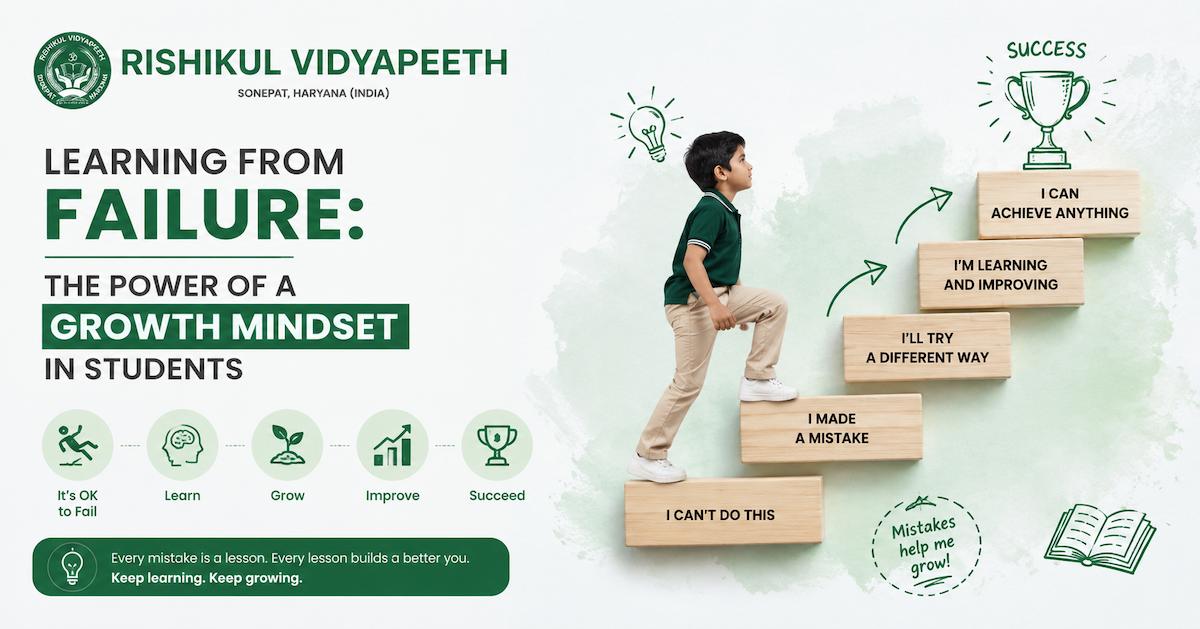
Learning from Failure: The Power of a Growth Mindset in Student
Failure is often viewed as something negative, especially when it comes to a child's academic performance. A low test score, losing a competition, making a mistake in class, or struggling with a difficult subject can sometimes make students feel disappointed or less confident.
But failure does not have to be the end of learning. When students develop a growth mindset, they can learn to see challenges and mistakes as opportunities to improve.
A growth mindset encourages children to believe that their abilities can develop through effort, practice, effective strategies, and learning from feedback. This approach can help students become more resilient, confident, and willing to take on new challenges.
What Is a Growth Mindset?
A growth mindset is the belief that abilities and skills are not completely fixed. Students may not be good at something today, but with practice, guidance, and persistence, they can improve.
For example, instead of saying:
"I'm not good at mathematics."
A student with a growth mindset may think:
"I don't understand this yet, but I can improve with practice."
That small change in thinking can make a significant difference in how a child approaches learning.
1. Failure Can Become a Learning Opportunity
Mistakes can provide valuable information. When students make an error, they have an opportunity to understand what went wrong and find a better approach.
For example, if a student performs poorly in a test, the experience can be used to identify difficult topics, improve study methods, and create a better preparation strategy for the next assessment.
The objective should not simply be to avoid failure. Instead, students should learn how to respond to failure constructively.
2. Encourage Effort, Not Just Results
Students often receive praise for getting high marks, winning competitions, or achieving excellent results. While recognising achievement is important, children should also be encouraged for the effort and strategies they use.
Instead of only saying, "You are very intelligent," parents and teachers can say:
- "You worked hard to understand this."
- "You kept trying even when it was difficult."
- "Your practice has improved your performance."
- "You found a new way to solve the problem."
This helps children understand that progress comes from effort and effective learning strategies.
3. Teach Students That "Yet" Matters
The word "yet" can change the way children think about challenges.
"I can't solve this problem" becomes:
"I can't solve this problem yet."
"I am not good at public speaking" becomes:
"I am not confident at public speaking yet."
This simple shift teaches students that their current abilities do not necessarily determine their future potential.
4. Let Children Solve Problems Independently
Parents naturally want to protect their children from difficulties. However, solving every problem for them can prevent children from developing independence.
When children face age-appropriate challenges, give them time to think, experiment, make mistakes, and try again before immediately providing the solution.
This develops problem-solving skills and teaches students that difficulties can be managed with patience and persistence.
5. Create a Classroom Where Mistakes Are Accepted
Students are more likely to ask questions and participate when they do not feel embarrassed about making mistakes.
Teachers can create a positive classroom environment by treating mistakes as a natural part of learning. Instead of focusing only on the incorrect answer, teachers can ask:
- What did you try?
- Where did the problem occur?
- What could you try differently?
- What did you learn from the experience?
This encourages students to participate without being afraid of getting something wrong.
6. Teach Resilience Through Challenges
Resilience is the ability to recover from setbacks and continue moving forward. It is an important quality for students because academic and personal challenges are unavoidable.
Sports, group projects, competitions, creative activities, and leadership opportunities can help children experience both success and disappointment in healthy ways.
When students learn how to handle setbacks, they become more comfortable with challenges and are less likely to give up when things become difficult.
7. Focus on Progress
Every student develops at a different pace. Constantly comparing children with their classmates can negatively affect confidence.
Instead, students should be encouraged to compare their current performance with their own previous performance.
Ask questions such as:
"What have you improved since last time?"
This encourages children to recognise their own progress and set realistic goals for continued improvement.
8. Teach Students to Learn From Feedback
Feedback should not be viewed as criticism. Constructive feedback helps students understand what they are doing well and what they can improve.
Teachers and parents can encourage students to listen carefully to feedback and use it to make changes.
For example, instead of feeling discouraged after receiving corrections on an assignment, students can ask:
"What can I do differently next time?"
This transforms feedback into a tool for growth.
The Role of Parents in Developing a Growth Mindset
Parents have a powerful influence on how children respond to success and failure.
Creating a growth mindset at home can involve:
- Encouraging children to try challenging activities
- Avoiding negative labels such as "lazy" or "not intelligent"
- Praising persistence and improvement
- Allowing children to make age-appropriate mistakes
- Discussing challenges openly
- Helping children set realistic goals
- Celebrating progress rather than perfection
Most importantly, parents can model a growth mindset themselves. When children see adults learning from mistakes, trying new things, and responding positively to setbacks, they learn that improvement is a lifelong process.
How Schools Can Encourage a Growth Mindset
Schools have an important role in creating an environment where students feel comfortable learning, experimenting, and making mistakes.
A growth-oriented school can provide opportunities through:
- Project-based learning
- Sports and extracurricular activities
- Group activities
- Leadership programmes
- Creative problem-solving
- Competitions
- Public speaking
- Experiential learning
- Individual feedback and mentoring
Such experiences allow students to understand that learning is a process rather than a race toward perfection.
Growth Mindset and Academic Success
A growth mindset does not mean that effort alone guarantees success. Students also need effective strategies, appropriate support, quality teaching, and regular practice.
However, believing that improvement is possible can influence how students respond when learning becomes difficult. A student who believes abilities can develop is more likely to seek help, practise, try another strategy, and continue working through challenges.
This persistence can contribute to better learning outcomes over time.
Conclusion
Failure is not the opposite of success; it can be an important part of the learning journey. Students who learn how to reflect on mistakes, accept feedback, remain persistent, and recognise their progress can become more resilient and confident learners.
A growth mindset teaches children that "I can't do it" does not have to be the final answer. It can become "I can't do it yet."
By working together, parents and schools can create an environment where children are encouraged to take on challenges, learn from setbacks, and keep improving. The goal is not to raise children who never fail, but to help them become children who know how to learn, adapt, and grow when they do.
