





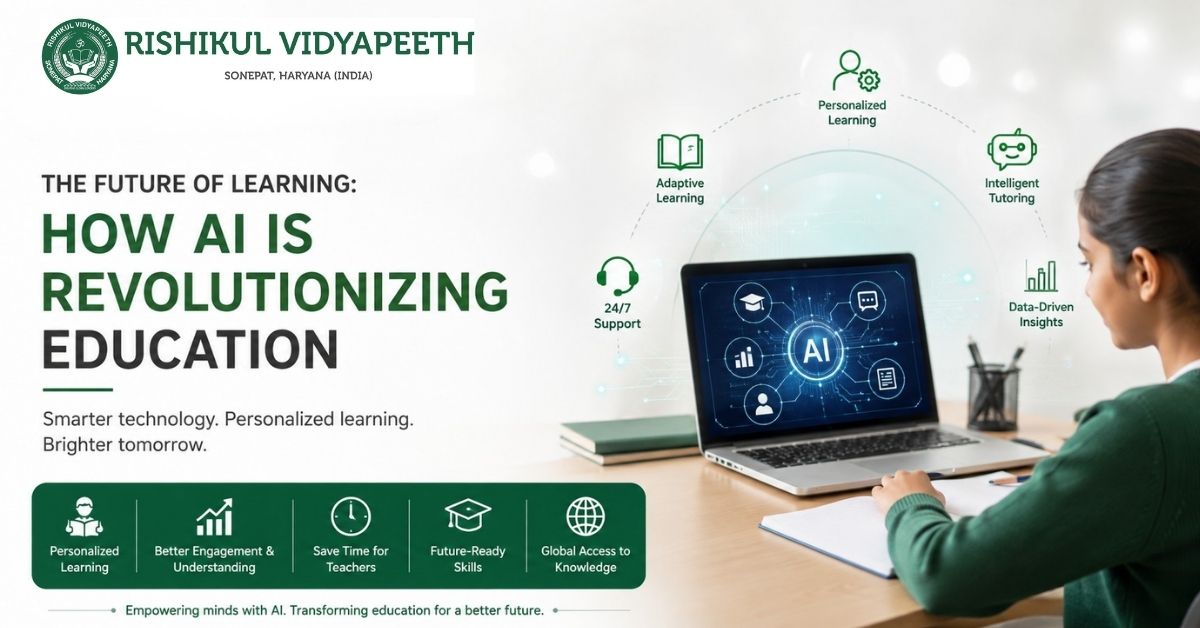
The Future of Learning: How AI is Revolutionizing Education
Education is changing rapidly with the advancement of technology. Among the many innovations influencing classrooms today, Artificial Intelligence (AI) is emerging as one of the most powerful tools for transforming how students learn and how teachers teach.
From personalised learning and intelligent tutoring systems to automated assessments and smart classrooms, AI is creating new possibilities for education. However, the goal is not to replace teachers. Instead, AI can support educators, make learning more engaging, and help students develop the skills they need for the future.
What Does AI Mean in Education?
AI in education refers to the use of intelligent technologies to support teaching and learning. AI-powered platforms can analyse learning patterns, provide personalised resources, answer questions, assist with assessments, and help educators understand students' academic needs.
Unlike traditional one-size-fits-all teaching, AI can help create learning experiences that are more responsive to individual students.
For example, one student may need additional practice with mathematics while another may be ready for more advanced problems. AI-based learning systems can help provide appropriate content based on each student's progress.
1. Personalised Learning for Every Student
Every child learns differently. Some students understand concepts quickly, while others may need additional explanation and practice.
AI can analyse student performance and identify areas where additional support may be useful. Learning platforms can then recommend exercises, educational resources, or activities suited to a student's current level.
This approach can make learning more flexible and help students progress at their own pace.
2. Making Classrooms More Interactive
Technology can make lessons more engaging by introducing interactive simulations, educational games, virtual experiences, and AI-powered learning tools.
Instead of simply reading about a scientific concept, students may be able to explore a simulation or interact with digital models. This can make abstract concepts easier to understand and encourage curiosity.
Interactive learning can also encourage students to participate actively instead of remaining passive recipients of information.
3. Supporting Teachers
AI can also benefit teachers by reducing some routine administrative work. Depending on the tools being used, AI can assist with tasks such as creating learning materials, organising information, generating practice questions, and analysing student performance.
This can give teachers more time to focus on what matters most: interacting with students, providing guidance, understanding individual needs, and creating meaningful learning experiences.
The teacher remains at the centre of education, while AI acts as a supporting tool.
4. Faster Feedback and Assessment
Feedback plays an important role in learning. Students need to understand what they have done correctly and where they can improve.
AI-powered assessment systems can provide rapid feedback for certain types of assignments and exercises. Students can use this feedback to identify areas that require more practice.
Teachers can also use performance data to identify common learning gaps and adapt their teaching strategies accordingly.
5. Preparing Students for Future Careers
The workplace is becoming increasingly technology-driven. As AI becomes part of different industries, students need to understand not only how to use technology but also how to think critically about it.
Schools can introduce students to concepts such as AI, coding, robotics, data, digital literacy, and responsible technology use. At the same time, students should develop uniquely human abilities such as creativity, communication, collaboration, empathy, critical thinking, and problem-solving.
The future will require a combination of technology skills and human skills.
6. Encouraging Independent Learning
AI tools can give students additional opportunities to explore subjects beyond the classroom. Students can ask questions, seek explanations, practise concepts, and explore topics that interest them.
Used responsibly, these tools can encourage curiosity and independent learning.
However, students also need to learn how to evaluate AI-generated information, identify errors, verify facts, and use technology ethically. Digital literacy is therefore becoming an increasingly important part of modern education.
7. AI and Inclusive Education
AI has the potential to make education more accessible for students with different learning needs. Tools such as speech-to-text, text-to-speech, language translation, personalised practice, and assistive technologies can help remove some barriers to learning.
When implemented thoughtfully, technology can provide additional ways for students to understand information and express what they know.
This supports a broader vision of education where different learning styles and abilities are recognised.
The Importance of Responsible AI Use
While AI offers significant opportunities, it also comes with challenges. Students need guidance on privacy, plagiarism, misinformation, over-reliance on technology, and responsible use of AI tools.
Simply giving students access to AI is not enough. Schools need clear policies and educators need to teach students how to use AI as a learning assistant rather than as a substitute for thinking.
The most effective approach is to combine AI-powered tools with strong teacher guidance and human interaction.
Why Teachers Will Always Matter
One of the biggest misconceptions about AI in education is that technology will replace teachers. Education, however, involves much more than delivering information.
Teachers motivate students, understand their emotions, encourage confidence, manage classrooms, provide mentorship, resolve conflicts, and inspire curiosity. These human connections cannot simply be replaced by an algorithm.
AI can provide information and support, but teachers provide context, encouragement, judgement, and human understanding.
Building an AI-Ready School Environment
Preparing students for an AI-driven future requires more than installing new technology. Schools need to create an environment where technology supports meaningful learning.
An AI-ready school can focus on:
- Digital literacy and responsible technology use
- Coding and computational thinking
- Robotics and practical learning
- Critical thinking and problem-solving
- Creativity and innovation
- Collaboration and communication
- Ethical understanding of AI
- Teacher training and technology integration
The objective should be to prepare students to understand, question, create, and responsibly use technology.
The Future of Education Is Human + AI
AI is transforming education, but the future of learning will not simply be about machines teaching students. It will be about combining the strengths of technology with the strengths of people.
AI can personalise learning, provide quick feedback, support teachers, and open new possibilities for exploration. Teachers can provide mentorship, empathy, inspiration, and meaningful human connection.
Together, these can create a more flexible, engaging, and future-ready education system.
Conclusion
The future of learning is being shaped by artificial intelligence, but technology should remain a tool in the hands of educators and learners. When used thoughtfully, AI can help make education more personalised, interactive, accessible, and relevant to the changing world.
For students, the most important preparation is not simply learning how to use AI. It is developing the ability to think critically, solve problems creatively, communicate effectively, work with others, and use technology responsibly.
Schools that successfully combine modern technology with strong academic foundations, experienced teachers, values, and holistic development can help prepare students not just for the jobs of tomorrow, but for a rapidly changing world.
